
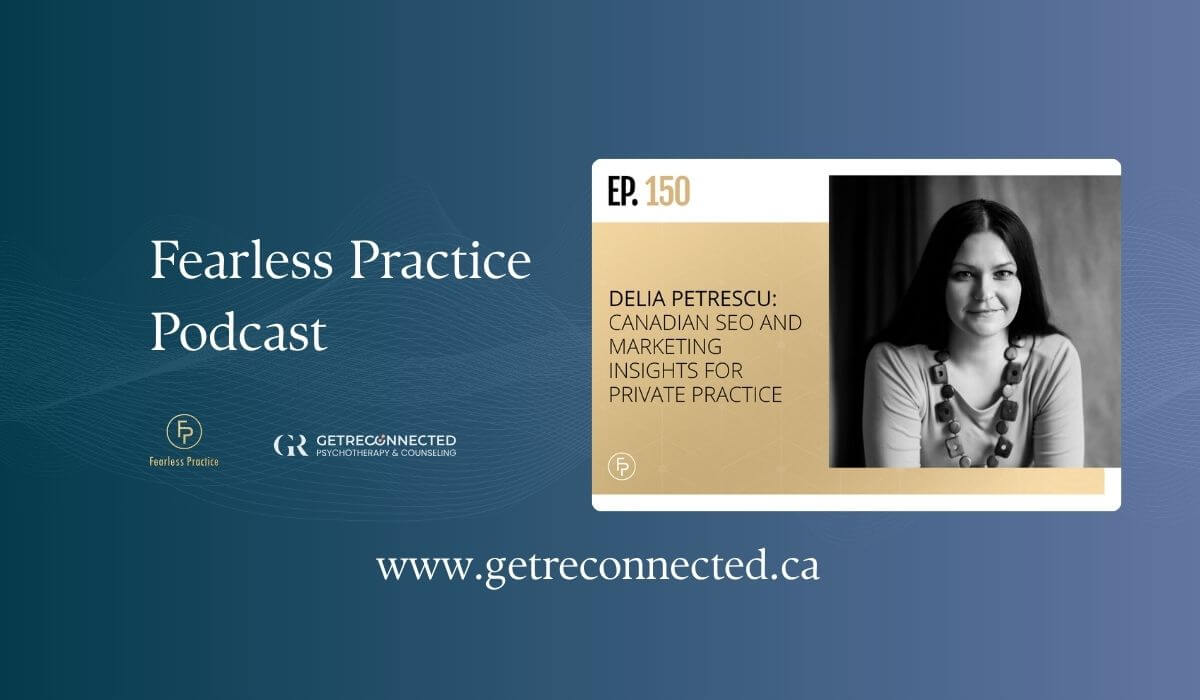
Delia Petrescu, MA, RP, founder of Get Reconnected Psychotherapy Services, joined Jules Smith on the Fearless Practice Podcast for Episode 150: “Canadian SEO and Marketing Insights for Private Practice.” In this episode, Delia shares her journey from working in neuropsychological research to building a thriving private practice, emphasizing the role of SEO and digital marketing in attracting clients.
Episode Summary
In this insightful conversation, Delia discusses:
- How her background in psychometry and neuropsychological assessments shaped her approach to therapy.
- The process of founding Get Reconnected and scaling it into a group practice.
- How SEO and marketing strategies have contributed to her success in private practice.
- The impact of niche specialization and content strategy in therapy marketing.
- Tips for hiring the right team and creating a values-driven practice.
- The balance between clinical work and business development.
This episode is a valuable resource for therapists looking to build or expand their private practice using effective digital strategies while maintaining a client-centered approach.
Listen to the Full Episode
🎙️ DELIA PETRESCU: CANADIAN SEO AND MARKETING INSIGHTS FOR PRIVATE PRACTICE | EP 150


Episode transcript:
Hello, and welcome to the Fearless Practice Podcast, where we talk about starting and growing Canadian private practices. I’m Jules Smith, and I’m so glad that you’ve tuned in. If this is your first time, please go rate and review. All right, let’s continue.
Hello and welcome back to the Fearless Practice podcast. Thank you so much for tuning in to today’s episode where I will be speaking to Delia Petrescu. Delia is a registered psychotherapist and founder of Get Reconnected Psychotherapy Services.
She has over a decade of experience working in the mental health field, supporting clients facing mood disorders, anxiety, infertility, pregnancy loss, relationship difficulties, and stress management.
Previously, she worked as a psychometrist in various clinical settings and at the Center for Addictions and Mental Health, CAMH, conducting neuropsychological assessments in the brain, body, and perception research department. Delia has specialized training from the American Society of Reproductive Medicine and is an active member of the Canadian Fertility and Andrology Society and Fertility Matters.
Hello and welcome to the podcast. Thank you so much for coming on.
Delia: Thank you for having me. This is a pleasure. I’m looking forward to our talk.
Jules: Me too. When I was researching you, yeah, I just found out so much and I love your marketing and website and I can’t wait to get into all of that. But before we get into it, what motivated you to pursue a career in therapy?
Delia: This might sound cliche, but I think since I remember myself, I was always interested in how the brain works and how people think and feel. But interesting enough, when I was about five years old and my older brother had started his grade one, I also wanted a notebook and a backpack so I could pretend around the house that I’m studying, that I’m going to school.
And when my parents asked me, what am I studying? My reply was psychology and philosophy, which is funny because even to this day. We still find it a funny story that we talk about, and none of us can figure out how I even knew these words at that age. That’s basically my start with psychology. But I started my professional journey working as a psychometrist.
And I was basically involved in doing testing for psychological, neurocognitive, neuropsychological assessments for brain injuries. Even though this role is really rewarding, I realized that my passion was actually in working directly with people to help them heal and feel better about themselves.
That’s basically what inspired me to go back to school and get my master’s degree in counseling psychology.
Jules: That’s so cool. And you went to Yorkville, right?
Delia: Yes, Yorkville. So I have a bachelor in psychology from York University and a master’s degree from Yorkville.
Jules: And I love that you worked at CAMH. I volunteered there when they used to have a telephone support helpline way back in the day.
And it’s just such a great organization.
Delia: Definitely, yeah. I had a very short tenure at CAMH. I was working as a psychometrist. I was basically a casual psychometrist there. So I was working in the research department. We were recruiting participants that had either an official diagnosis or diagnosed with body dysmorphia.
I would do the assessment to see if they qualify for the study. That was really interesting and I learned a lot from CAMH. It was such a great team with the psychiatrist and everybody else involved there. It was a bittersweet feeling to actually leave.
Jules: Did you incorporate any of what you learned during that time into being a therapist?
Delia: Actually, the assessment piece can really help even as a therapist for the intake, certain questions that we need to ask. For example, one of the criteria was whether you meet the criteria for an ADHD diagnosis. And I found that that is really important. Sometimes when I’m having a first session with a client, it’s important to ask some questions that would actually put a bigger perspective, would put the pieces of the puzzle together.
It helps you to understand what’s going on. Though as therapists, we can’t legally diagnose. It’s just really good to have that information like, okay, I see where you might lie.
Jules: Exactly.
Private practice. Did you start right after you graduated from Yorkville University?
Delia: Yes. I was still working as a psychometrist and I was working full time while I was doing my practicum at Yorkville University for about eight months.
I switched from full time to part time and as soon as I graduated, I took a leap of faith. I quit my job and I went straight into private practice. So basically founding Get Reconnected was a dream come true. My goal is always to create a virtual practice, like a go to spot, where we can offer specialized services for a wide range of difficulties.
So I knew from the moment I founded Get Reconnected that I don’t want to be a solo practitioner, that I want to create a group practice. That definitely helped with the vision and planning.
Jules: How did you plan for starting a private practice?
Delia: I was lucky that my husband is a marketing strategist and SEO consultant.
So I had the backend and what happened was at first I was really interested in just doing therapy and I wanted him to just help me with the backend. But then I got to the point that I was really interested in how it works. And now I’ll be honest, I’m interested in actually doing both works. To be the business owner and SEO analytics and the keywords and everything that comes behind it and also doing the therapy part.
Jules: I love that. That’s exactly what I found out this past year too. I love the backend SEO work and maybe that’s because you see the results right away. It’s very satisfying and with therapy with clients, things can take a while.
It can go in lots of different directions. There’s just something about doing that backend work that just feels so satisfying and a little nerdy, which I love just getting into the analytics.
I used to be a psychiatrist, right? So for me, you know, the analytical aspect of it, you know, checking for stuff that works.
Delia: But I wanted to just touch base a little bit when you said that it’s quick. The thing is with SEO, it’s not that quick. It does take up to a couple of months in order to actually see the organic traffic. At first, I was skeptical, you know, like, why do I need to do so much content and backlinks, making sure that Google sees you as an authority, but as the months went by, I noticed so much organic traffic from my website.
And that was great. Definitely a motivator to keep going.
Jules: So when did you open up your private practice?
Delia: I opened up in 2021. I believe it was like June or July. I don’t remember exactly the month.
Initially, I was just relying on the Psychology Today profile and I didn’t have any word of mouth referrals because I was still fresh. I was still new. I didn’t start with paid advertising until probably a year later, at that point I was just relying on directories.
Jules: And was that Google paid advertising, social media paid advertising?
Delia: Both. So it was Google paid ads and also Meta: Instagram and Facebook.
Jules: What did you find worked the best?
So we would have sessions between 25 to 45 depending on affordability. The thing is throughout the interview process, I actually liked two interns and I ended up taking on two instead of just one.
Jules: When did you go from solo private practice to group private practice?
Delia: It was actually within that year. So when I started doing paid advertising, Facebook and Instagram, that’s when I did the switch.
I would also help student interns find the practicum place and also help prospective clients find something suitable financially. Exactly.
Jules: I assume it feels really great to help students learn therapy, learn how to do it, as well as for you helping clients that can’t afford full fees that you can offer that service to them.
How did you find your interns?
Delia: So I posted on Facebook groups, made an ad through Canva, and I was also posted on the Yorkville practicum portal that I’m basically a virtual clinic that offers placements.
Jules: And with Yorkville, are they allowed to do a complete practicum online, or do they need in person hours as well?
Delia: They’re allowed to be completely virtual.
As long as the clients are from Ontario, it’s fine. Virtual is the way to go.
Jules: You’re preaching to the choir. I only have a virtual private practice too, and I love the flexibility of it. And like I was saying, for the holidays, being able to visit family and still work is great.
How has it been the past couple of years since you started that?
Delia: We’ve been actually growing exponentially. So 2022, I believe it was in September, August, September, that’s when I got the first students. After that, I also hired part time another colleague that I work with at a different clinic. She was also looking for work.
She was in private practice and she was working for other clinics and she couldn’t find a client. And then I also hired a psychologist as an independent contractor. It was a psychologist that I collaborated before for a psych assessment. So as of right now, we’re actually a team of seven. So the two student interns that graduated, they remained with me as independent contractors.
And now we have two student interns that started in September, again.
Jules: How is it like managing that large of a private practice as well as doing therapy yourself with clients?
Delia: Yes, I also do therapy myself. I would say I’m doing it full time. Well, I was taking on a lot more clients before, but now I’m trying to scale it down.
It’s not as complicated as I thought it would be. I guess it’s having the right fit of independent contractors and for the student interns has definitely helped. I do have weekly meetings with the intern therapist. With the contractors, it’s only on a needed basis if they need to talk to me, if there’s any issues.
Jules: As you’re thinking more about right fit, is that where the values come into play when you are thinking of bringing on an intern? I saw on your website that you speak about your values in private practice.
Delia: A hundred percent. And I think we kind of shifted a little bit of the values from the beginning of the website, but it’s almost like values you have to continuously assess and figure out what works for you, what works for you as a team and what works as the vision for the practice.
And you’re right, 100 percent the good fit for the independent contractors would have to match the values. Since we’re talking about this, maybe I can tell you a little bit of some of the values of our practice.
So the first one, it’s actually curiosity. And I made sure that when I was hiring the student interns and the independent contractors, that we all kind of shared that genuine curiosity about each client and to bring that curiosity to each session as well.
So basically my motto is, we are always curious about our clients. And then we’re hoping that through sessions, they become curious about themselves. And this is something that I will always remember what my supervisor said when I first started as a therapist. And she said, curiosity is your superpower.
And I found that it was so brilliant. And it’s like, it’s stuck with me.
Jules: That’s why, as a narrative therapist, curiosity, asking questions is such a big part of that, and I once heard way back, like maybe 11 years ago, to be a good therapist is to ask really good questions, because that’s going to make the client think about their life in different ways.
So I love that value of curiosity. What other values do you have?
Delia: I guess the second value would be the dedication. So for me as a business owner and as a therapist, I pretty much have to go the extra mile to ensure that my contractors are well paid by offering them a competitive fee split. We have a Google Doc with tools and resources, occasional workshops and courses.
So basically the value is to always provide the best service that the client can get. And I get that as a business owner by including contractors getting trained and having access to the latest research treatments and for them to have that hunger for knowledge, right?
Jules: Is it helpful that the interns become contract workers with you that you can assess their hunger for those things?
Delia: Yes, it does. It’s almost like they learn how my practice works. So if it’s a good fit for them, then they can stay. And also if I find that it’s a good fit that they integrate so well with the values, the mission and everything else, how I have it set up, then it’s great. Then it’s perfect. It’s like a matching glove.
Jules: What’s your mission?
Delia: So the mission is kind of like twofold. We want to make sure that the clients, they’re able to reconnect to the best version of themselves. So we want to be able to offer them the solution to the problem that they have. So that is basically the mission.
Jules: I love that. With the mission, with your values, I’m going to make a transition here into marketing.
How do you market that? And how does that help get clients by advertising values and mission statements?
Delia: So basically what I’m advertising, what worked for me really well, especially with the SEO and everything is to have specific niches. So it’s not necessarily advertising for the values and the mission because a lot of the time clients don’t really know what that means, especially when I say, well, I want to make you reconnect to the best version of yourself.
A lot of the time it’s like, well, how do I know what’s my best version of myself? Right? So basically when you have a specific and clear niche, you have to be intentional to really understand what the client is really struggling with it? Like, what is that problem? What is the issue that you’re trying to solve?
And then get really clear about like, okay, what is the solution that you’re offering? That can really make wonders when it comes to the marketing strategy. For example, I’ll give you an idea. In our group, we have specialized practices. So we have one therapist that’s specialized in phobia, particularly agoraphobia.
One of the marketing strategies for that is a lot of the times clients that have that fear of leaving the house. They describe themselves as being a hostage to their own home. That was actually key for when doing advertising, right? So it’s asking the right question for the client to be like, Oh, that’s exactly me. That’s exactly how I feel.
You kind of grab their attention and then you let them know, okay, this is how we can help. book of reconsultation and blah, blah, blah.
Jules: Do you use AI to help figure out copy or how to market?
Delia: I definitely use ChatGPT for ideas. I’m not particularly a big fan of writing blogs or content with ChatGPT.
I can tell. I have people reaching out with resumes and cover letters, and I can so tell from a mile away that it’s ChatGPT. I cringe when I see it. One good platform to find out the struggles, the pain points, as we all know what it is, it’s using Reddit or Quora.
So it’s like regular people are talking on those platforms and how it feels for them, what they’re struggling with.
Jules: It’s a great place to go to hear exactly how people are feeling.
Delia: And then if you’ve been doing this for a while, right, like you kind of see patterns that each client brings up to the session. It’s like, okay, so someone who’s afraid of going out, there’s something there that it’s a common denominator. So you can use that.
Jules: I really like on your website with your blog that you have sectioned off different themes or different niches. And then have blogs for those and knowing backend SEO work that is really helpful too to section them off.
Delia: So you know how a lot of therapists always say that they have the website to be targeted for your specific niche, but it’s so much harder when you have a group practice, unless you have a group practice that it’s the same niche.
So for example, for me, my niche is infertility and burnout. I would have had to hire contractors that deal specifically with that. But for me, because I wanted to kind of create like a hub of, you know, like we cover a wide array of difficulties. Having different service pages and different blog content can actually really help with that SEO, right?
Because it’s all about that keyword. And it’s about convincing Google that you’re an authority, right? So it’s like whenever somebody is Googling, well, I’m afraid of going out or leaving the house or I’m struggling to conceive. You want to make sure that Google says: Oh, you know what? Delia at Get Reconnected deals with that; let’s pop it up on the first page.
Jules: Yeah, exactly. And to add to that, if you are starting to blog, you might not want to just say how to help with fertility because that’s such a general thing that it might be harder to rank in Google for that. So you might want to be more specific to people in Vaughan that are struggling with infertility this is one way to help or like making it a very longtail keyword. I assume that’s what you did to help get up is niching even the keywords.
Delia: Yeah, but it’s also the analytics behind it, right? And that’s when someone that specializes in SEO will know exactly which tools, what kind of things to use.
Because basically you want to know what the client is, what is the person googling? What is that question that they’re asking for you to be able to use those keywords?
Jules: Yeah, exactly. And there’s so many ways, luckily, to easily find out how people are Googling and searching. You can just go incognito and start typing in a question and then you’ll see Google’s recommendations and then you know that’s what people are asking.

Delia: Just one more thing about SEO. So it’s basically When I first built the website, it took a while for Google to see me as an authority for infertility specifically. So I think when I first launched the website, I was probably on the seventh page. And then within a month, I think I went to the fifth page.
And then right now it’s been, I think it was probably the seventh or the eighth month I’ve been on the first page on infertility. It takes a while, but it’s definitely all the content that you’re putting out there.
Jules: Content, strategizing, keyword, backlinks, all these things. For anybody listening, if you have a WordPress website, Yoast SEO, just for, I think, 99 a year, you can get amazing courses on how to do this work yourself.
So it doesn’t have to be expensive. You don’t have to pay somebody a lot of money to do this work. You can do it yourself and learn it. That’s how I’m doing it right now. And it is just amazing the information that they teach you on just how to work your back end so that your webpage ranks higher.
Delia: And now with the AI? Yeah, even better.
Jules: I guess there’s a dark side to AI. From what I’ve heard, if you’re just posting AI blogs, Google’s going to see that and dock you points. Because they know it’s AI and they don’t want that. They want new content, rich, new content. Beware out there if you’re like, Oh, I’ll just blog every day with an AI blog and just change a couple of words.
Beware about that. Look into it, talk to some experts about it, because from my understanding, that could be a detriment to your website.
Delia: 100%. And I wanted to add something on that. For Google, if you’re copying and pasting biographies or content, that is actually in detriment to your website as well, because Google sees, well, hold on a second, which one is plagiarized? Is it you or is that person, right?
A lot of the time with the AI, when it’s generated so frequently, how do you know that another therapist is not using that exact same information that was like, spit from chat GPT? And that would be seen as like, wait, hold on a second, that therapist X, right? Or YZ, they’re using the same content.
Jules: So just one last thing about marketing, or maybe a couple things wrapped into one. Your website is amazing with how you have marketed it. There’s YouTube videos. There’s a newsletter. There’s As Seen On. How did you compile all of that work and put it onto your website? How long did it take? And how are you doing all that work?
It’s amazing.
Delia: Yeah, it was a slow process. I think I started first with a blog. That I added on the website and then as seen on those are HAROs. So it’s basically short for helper reported out. So there are those things that some reporters ask a question and then you can answer the question.
Then that’s how you get the backlink basically. And that’s what helps you to rank for Google to see, Hey, you know what? Delia and Get Reconnected, they’ve been mentioned. And it also matters who’s giving you the backlink. I mean, if you’re getting a backlink from a big website, for example, such as yahoo.com, that’s big, right? So then Google will be like, well, Delia is an authority when it comes to infertility or burnout or whatever I’m trying to target.
Jules: I’ve heard my assistant saying that we always get emails from people being like, Hey, can we post a blog on your website? And I’m assuming that’s what they’re searching for is that backlink to be more authoritative.
And also I’ve heard from the Yoast courses that I’ve taken, some people just sneak in their backlinks on other websites and how that can again be a detriment. You ought to be strategizing where you want your backlinks because if it has nothing to do with therapy, it’s not going to do that much.
Delia: Or it depends on what kind of website, right?
Like I’ve seen some bad stuff. You don’t want to land on one of those websites as a therapist. I know you also mentioned the therapy newsletter and the YouTube videos.
Like I looked at all the directors and platforms and I realized that I wanted to kind of get a feel of how the therapist is talking, how the therapist is before I even book a consultation. Because, you know, time is very limited for a lot of people, myself included, and then I started thinking, I think clients feel this way as well.
So I figured instead of having just a bunch of writing with prospective clients, people in general don’t read that much, I decided to have that YouTube video just to kind of explain how we’re doing therapy, explain a little bit of our team.
Jules: What I’ve understood about copy is a lot of times people aren’t going to read that, but if you have a video on your website, people are going to gravitate to just listening to that and making a decision from that video.
Delia: A hundred percent. And just because you said people don’t really read stuff. So my Psychology Today is strictly about infertility and pregnancy losses. You’d be surprised how many inquiries I get that has nothing to do with fertility or pregnancy laws. I’m like, well, how did you even land on my page?
Jules: Yeah. That’s the funny thing about marketing is we can make all these assumptions of why people choose us, but because it’s such an individualist thing of finding a therapist for yourself, so many people have different criteria of why they want to work for somebody. Maybe it’s the color of your hair. Maybe it’s the way you smile. Maybe it’s because you have a video, there’s just so many physical features to your expertise, to where you went to school, you just have no idea why somebody is choosing you and that can be really fun because with niching, there’s always that fear of, oh, if I niche, then nobody else is going to want to see me.
That’s usually not the case.
Delia: Well, I’ll be honest, a lot of my clients are not just infertile. There’s a variety of problems that I’m targeting in sessions, not necessarily that.
Jules: Successes, struggles that you’ve encountered along the way?
Delia: Yeah. So basically, I wouldn’t say it’s necessarily a struggle, but one of the first lessons that I learned, I think I mentioned at the beginning that I couldn’t rely entirely on psychology today and word of mouth to kind of get that constant stream of referrals.
Even though I had a background in sales prior to my psychometry work, this was still a hard road to follow. Selling my own services felt a lot tougher than selling a product. So that was something that I had to kind of learn along the way. Okay, how do I express myself? How do I basically portray myself as a therapist?
How do I portray myself of what is the problem that I’m trying to solve with clients or how can I help them? And I guess the hardest lessons that I’ve had to learn was to avoid the trap of comparison, right? And it’s so easy to compare yourself to others’ successes, especially when you go on Facebook.
And it never serves you.
And I know that, you know, as humans, we’re wired for that social comparison, fitting into a group is crucial for survival. Once I realized my spiraling patterns, and I was getting myself into this habit of comparing myself, having self doubts, that’s when I tried to kind of reframe my thoughts and then now I’m kind of asking myself, okay, what am I feeling right now?
Is this something that I need to take action on? So if I see something, do I like it? Is this something that I kind of want to integrate? Or am I starting to feel the self doubt? And that was a big difference, right? Because I started to kind of operate out of fear. A lot of the time, Oh, I need to do that.I need to do that. I should be doing this. So a lot of shoulds and musts. That was not helping me.
Jules: All right, so being aware of how you feel when you’re on social media, as well as being clear with your strategy and being like, yeah, this is all great, but this is my focus. Yeah. This is what I’m going to do.
Not to deviate from my plan.
Jules: I get that. With the fearlesspractice.ca Instagram’s, it is solely just other private practitioners in Canada, mostly some in the US too, which is great. So when I go on there, it’s just an overwhelm of all these amazing private practices doing great posts and great things in their private practice, which can be celebrated, but then also like, oh, gosh, am I doing enough?
So I always have to be aware when I go on to that platform.
Delia: And I think this is universal to every single therapist. I don’t think there’s one therapist out there. And if you find one, please let me know, that you don’t feel this way.
Jules: What do you want to do in the future? Where do you see your private practice going?
And I guess more of a long term goal, this is probably like a three to five year goal, is to have an office space in downtown and then to also have office spaces in the areas where the contractors are because we’re kind of spread around the GTA.
That’s basically the goal for the future of the practice to kind of have in person as well.
Jules: Exciting. Thank you so much for coming on the podcast. It’s been a pleasure to talk back end SEO strategies with you. I love that stuff. So it’s just great to meet a fellow person that is interested in that as well. And to learn about your private practice. Congrats on all your success. It’s amazing.
Delia: Thank you. And I appreciate it. Thank you for having me. And this was great. It was a pleasure. Pleasure meeting you and talking about this.
It’s exciting to talk about it.
Jules: And thank you so much to Jane app for sponsoring this episode.
I love and use their EMR, especially how easy it is to make an online intake form. You can check them out at jane.app/mental health. And remember to use the code fearless for one month free.
Thank you for listening to the fearless practice podcast. To sign up to receive my free e course on how to start an online Canadian private practice, please visit fearlesspractice.ca/start.
This course is for Canadian counsellors who want to start an online private practice but have no idea how to do it. By the end of this course, you will know everything you need to in order to launch your own private practice.
This podcast is designed to provide accurate and authoritative information in regard to the subject matter covered.
It is given with the understanding that neither the host, the publisher, or the guests are rendering legal, accounting, clinical, or any other professional information.